
Teams, delegation and memory
Let agents delegate to each other, build teams and keep long-term memory.
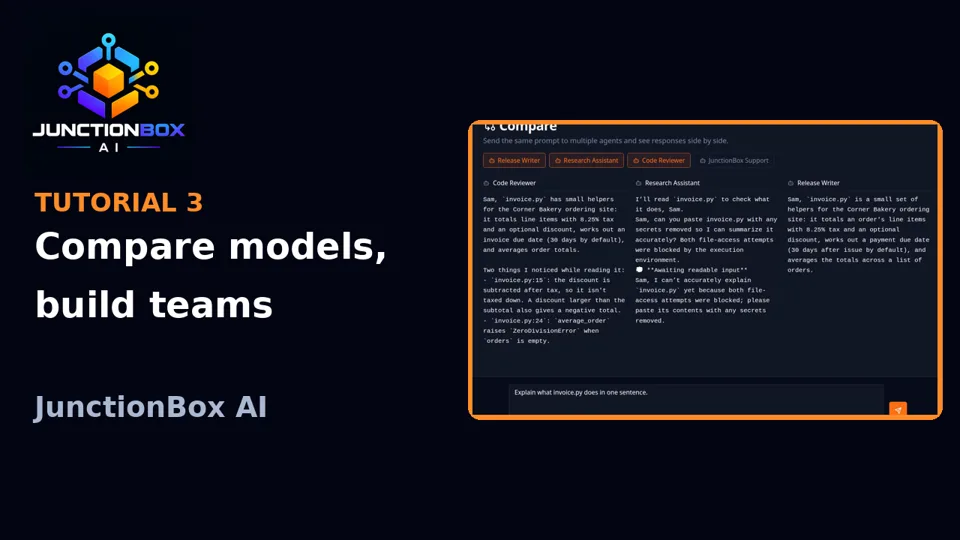
Delegation and Teams
Anthropic, Ollama, and Claude CLI agents can delegate a sub-task to another agent directly inside their own conversation, without you doing anything — this is what makes multi-agent workflows possible.
- An agent can only see and delegate to agents it shares a Team with. Put two agents on the same team to let them collaborate; leave an agent off every team (or give it an empty-roster team) to keep it isolated.
- Delegation depth is capped at 3 levels to prevent runaway chains.
- Watch delegation happen live on the Orchestrator page — a graph of the originating agent, each delegated task, and its status.
- The Teams page also has a convenience "apply to team" action to flip the operating-context/plugin-creation-context toggles for every member at once.
Memory and agent identity
Two independent, off-by-default toggles let agents remember things across conversations:
- Memory capture — JunctionBox proposes candidate memories (facts, preferences, decisions) from what you say in a run, using pattern matching (not an AI guess) so it stays predictable. Nothing is remembered automatically — review and approve/reject candidates on the Memory page.
- Memory injection — once a memory is approved, relevant ones get pulled into future prompts automatically, scoped either to one agent or shared globally.
Structured identity (per agent) is a separate, more deliberate persona definition — role, tone, values — with its own version history, diffing, and restore, edited from each agent's Identity dialog.
Source: USER_GUIDE.md in the public releases repository.